Colusa Riverside Alpacas' mission is to advance the alpaca and
the alpaca industry. One way we do so is by providing the public
with valuable learning material in the form of educational alpaca
articles published and written by author/owner Sheila Scroggins,
as well as other public learning resources and materials. Please
enjoy our articles...
Expected Progeny Differences |

Click to view larger image
Want to learn about EPDs? Sheila can provide education on the topic for individuals or group audiences. References on her educational seminar welcomed upon request.
|
| |

|
A Cure for the Dummy Cria Syndrome: The Squeeze Maneuver
By Sheila Scroggins of Colusa Riverside Alpacas, RN, MSN, FNP
Published in Alpacas Magazine in the 2016 |
 At the spring Calpaca (California affiliate of AOA) meeting, U.C. Davis Professor of Equine Medicine and Epidemiology Dr. John Madigan presented new research on the syndrome of dummy foals, and a methodology to reverse it. Equine neonatal maladjustment syndrome is more popularly referred to as dummy foal syndrome. Dr. Madigan’s research findings have become known as the “squeeze method.” Dr. Madigan is the principle researcher in the “Clinical Trial of the Madigan squeeze method for treatment of equine neonatal maladjustment syndrome.” This groundbreaking research has clear application to the health and welfare of alpacas – read on to find out how. At the spring Calpaca (California affiliate of AOA) meeting, U.C. Davis Professor of Equine Medicine and Epidemiology Dr. John Madigan presented new research on the syndrome of dummy foals, and a methodology to reverse it. Equine neonatal maladjustment syndrome is more popularly referred to as dummy foal syndrome. Dr. Madigan’s research findings have become known as the “squeeze method.” Dr. Madigan is the principle researcher in the “Clinical Trial of the Madigan squeeze method for treatment of equine neonatal maladjustment syndrome.” This groundbreaking research has clear application to the health and welfare of alpacas – read on to find out how.

Read
the full article
|
| |
|
Copper Deficiency and Alpaca
Disease, a Case Study
By Sheila Scroggins of Colusa Riverside Alpacas
Published in Alpacas Magazine in the Autumn 2015 issue |
 How can we uncover any emerging or re-emerging disease in New World camelids unless we look for the cause of death when we lose an alpaca? This dilemma ultimately faces all owners at some point when raising alpacas. How can we uncover any emerging or re-emerging disease in New World camelids unless we look for the cause of death when we lose an alpaca? This dilemma ultimately faces all owners at some point when raising alpacas.
Finding the reasons for a death is good for our camelid medicine, and it is good for each owner, even if just for curiosity reasons, not to mention to ensure we are not dealing with a contagious disease.
For me, the most important reason to determine cause of death is to add to the body of medical knowledge on alpacas. The cost is well worth it. There could be diseases emerging in the alpaca, diseases seen in other species, but not yet seen in the camelid. This is a case report about a well-known disease, and a not-so-well-known disease. As you will see, even when the cause of death is determined, you can be left with more questions than answers.

Read
the full article
on copper deficiency in alpacas
|
| |
|
A Medicine Room and its Usage
By Sheila Scroggins of Colusa Riverside Alpacas
Published in International Camelid Quarterly, September 2015 |
 Do you have a room exclusively for medications and medical supplies for your herd? In my opinion it is a necessity for any alpaca owner. As a nurse practitioner who has worked in many medical offices and hospitals, I know each has a room to store and dispense medical supplies and medications. While I try to prepare for convenience and the ability to treat just about anything on the farm, my supplies are meant to treat minor medical problems, as well as the moderate medical problems I feel comfortable handling. Included in the medication room is everything I need for herd health, both in refills and a mobile medication supply bucket to take into the field. Do you have a room exclusively for medications and medical supplies for your herd? In my opinion it is a necessity for any alpaca owner. As a nurse practitioner who has worked in many medical offices and hospitals, I know each has a room to store and dispense medical supplies and medications. While I try to prepare for convenience and the ability to treat just about anything on the farm, my supplies are meant to treat minor medical problems, as well as the moderate medical problems I feel comfortable handling. Included in the medication room is everything I need for herd health, both in refills and a mobile medication supply bucket to take into the field.

Read
the full article
|
| |
|
What Should You Put in the Cria Baby Bottle?
By Sheila Scroggins of Colusa Riverside Alpacas
Published in Alpacas Magazine in the Spring 2012 issues |
 Conventional wisdom says cow or goat milk is a good substitute for alpaca milk. My research indicates neither of those are the most optimum milk substitute. Recently, we bottle fed a cria for two months with a unique formula that produced good results. I pursued further research to see if my choice of formula had real validity. What I learned may help others with bottle-fed crias. Conventional wisdom says cow or goat milk is a good substitute for alpaca milk. My research indicates neither of those are the most optimum milk substitute. Recently, we bottle fed a cria for two months with a unique formula that produced good results. I pursued further research to see if my choice of formula had real validity. What I learned may help others with bottle-fed crias.
Read
the full article on the best
formula to feed alpaca crias
|
| |
|
Make Your Own Electrolyte Paste
By Sheila Scroggins of Colusa Riverside Alpacas
Published in International
CQ Camelid Quarterly magazine in the December 2011 issue |
 id you know there may be times when you can help your adult alpacas by providing them with supplementation of electrolytes? It may be that dam who decides to give birth in the spring during an unexpected heat wave. It could be in a condition described to your veterinarian over the phone where the recommendation is to supplement your alpaca with an electrolyte. There is an easy recipe you can prepare and have on hand which can provide a quality, easily stored, and easily administered form of electrolytes. And best of all it will only cost pennies per dose. id you know there may be times when you can help your adult alpacas by providing them with supplementation of electrolytes? It may be that dam who decides to give birth in the spring during an unexpected heat wave. It could be in a condition described to your veterinarian over the phone where the recommendation is to supplement your alpaca with an electrolyte. There is an easy recipe you can prepare and have on hand which can provide a quality, easily stored, and easily administered form of electrolytes. And best of all it will only cost pennies per dose.
Read
the full article on how to make
your own electrolyte paste
|
| |
|
The Perfect Storm: Case Study of a Septic Cria
By Sheila Scroggins of Colusa Riverside Alpacas
Published in Alpacas
Magazine in the 2011 Herdsire issue
|
 his
case study is about Moon River, a beautiful alpaca cria that
was born healthy. She appeared by all measures to be normal,
but lived for only four short days. Moonie, as we nicknamed
her, succumbed to an infectious process, the result of insufficient
amounts of colostrum in the first hours of her life. All this
was unbeknownst to her owners, until it was too late. My hope
in writing this case study is that you develop an understanding
of the consequences for a cria who fails to get enough colostrum
in the first 12 hours of life. "Sepsis is a severe illness
in which the bloodstream is overwhelmed by bacteria." his
case study is about Moon River, a beautiful alpaca cria that
was born healthy. She appeared by all measures to be normal,
but lived for only four short days. Moonie, as we nicknamed
her, succumbed to an infectious process, the result of insufficient
amounts of colostrum in the first hours of her life. All this
was unbeknownst to her owners, until it was too late. My hope
in writing this case study is that you develop an understanding
of the consequences for a cria who fails to get enough colostrum
in the first 12 hours of life. "Sepsis is a severe illness
in which the bloodstream is overwhelmed by bacteria."

Read the full article on
septic crias
|
| |
|
EPDs - They’re Heeere!
By Sheila Scroggins of Colusa Riverside Alpacas
Published in International
CQ Camelid Quarterly magazine in the spring 2011 issue
|
An EPD is an Expected Progeny Difference (EPD). It has been
my experience that when you ask an alpaca breeder if their
alpacas have been EPD tested and what are their herdsire's
values, I usually get a look of utter astonishment. They have
of course, heard of EPDs, but seem to be confounded by the
thought that someone might ask. I doubt if a person was shopping
for a bovine stud they would get the same response from a
breeder.

Read the full article on
alpaca EPD's
|
|
|
|
How Productive is Your Website?
By Sheila Scroggins of Colusa Riverside Alpacas
Published in the Calpaca
Connection in March, 2011
|
 In
1990, with lightning speed, the means for finding information
for the general public went from the library to the Internet.
The Internet started by linking universities and quickly spread
to its use by the public. Hence came the vernacular "Google
it". So when someone wants information about alpacas
they will "google it". The words they choose to
seek information will depend on many variables; however the
results you want is for that person to link to your website.
The only way to do that is either pay a significant amount
of money each year to a web optimization service or to do
it yourself. In
1990, with lightning speed, the means for finding information
for the general public went from the library to the Internet.
The Internet started by linking universities and quickly spread
to its use by the public. Hence came the vernacular "Google
it". So when someone wants information about alpacas
they will "google it". The words they choose to
seek information will depend on many variables; however the
results you want is for that person to link to your website.
The only way to do that is either pay a significant amount
of money each year to a web optimization service or to do
it yourself.
Most alpaca literature indicates the most common means of
generating sales for an alpaca business today is through web
searches. A majority of alpaca are purchased over the Internet,
sight unseen.

Read the full article on
alpaca websites
|
| |
|
Confessions of New Alpaca Owners or Better Said: “Who
would have thought.”
By Sheila Scroggins of Colusa Riverside Alpacas
Published in the Calpaca
Connection for the first quarter of 2010
|
 My
husband Dave and I started a new alpaca business just like
you. We were three months into the business and all I can
say is what did people do before the Internet. Thank goodness
for the Internet. Of course, it was a recession, right, we
couldn't start with two alpacas like everyone else. No, no,
we started with 10 alpacas and two llamas. You know the thinking,
why start with two when you can get 10 for the same price.
Sounds good, right? Who thinks like this? Someone with no
knowledge about alpacas? I hope you enjoy my look into the
past with humor and I hope you can say to yourself, thank
God I am not there anymore too! My
husband Dave and I started a new alpaca business just like
you. We were three months into the business and all I can
say is what did people do before the Internet. Thank goodness
for the Internet. Of course, it was a recession, right, we
couldn't start with two alpacas like everyone else. No, no,
we started with 10 alpacas and two llamas. You know the thinking,
why start with two when you can get 10 for the same price.
Sounds good, right? Who thinks like this? Someone with no
knowledge about alpacas? I hope you enjoy my look into the
past with humor and I hope you can say to yourself, thank
God I am not there anymore too!

Read the full article on
new alpaca owners
|
|
|
|
Making a Case for Necropsy in the Alpaca
By Sheila Scroggins of Colusa Riverside Alpacas
Published in the summer 2010 issue of International
CQ Camelid Quarterly magazine
|
There is an old saying in medicine, “When
you hear hoof beats, don’t look for zebras.” It
loosely suggests that, when a doctor, or in this case a veterinarian,
sees symptoms of a disease, the most common cause of the symptoms
is usually the culprit. In the case of a common infection
this adage is a simple reminder for doctors that a fever is
more likely a cold or flu – and not infectious endocarditis.
Which brings me to the purpose of my article which is to
inform my fellow alpaca ranchers of a rare illness found in
one of our alpacas. In other words, the rare hoof beat that
was in fact, a “zebra.” More importantly, I hope
to alert you in how not to miss that alpaca with the rare
disease. The one that can add to the body of knowledge for
all alpaca owners, enabling them to better understand disease
in the alpaca...
Read the full article on
necropsy of alpacas
|
|
|
|
Make the Most of Your Local
Veterinary Resources
By Sheila Scroggins of Colusa Riverside Alpacas
|
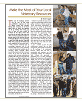
The cost of veterinary services can be one of
the most prohibitive expenses for the alpaca owner and breeder.
During this recession, we all know alpaca sales are down,
but expenses can be up. During these times, any way to save
on costs would be welcome by any alpaca owner. One novel way
to cut some of the costs is to allow veterinary technician
students to provide some of the services that you would typically
have your veterinarian, or paid ranch help, provide. Especially
those once a year type of services you need completed for
your entire herd...
Read the full article
|